Steps to Mastering AI: A Practical Roadmap for 2026
You see the headlines. Every week, a new artificial intelligence model breaks records. It writes code, diagnoses diseases, or generates photorealistic images in seconds. You feel the pressure. You know you need to learn this stuff, but where do you even start? The landscape is messy. There are too many courses, too much jargon, and too many promises of "getting rich quick" with AI.
The truth is simpler than it looks. Mastering AI isn't about memorizing every algorithm. It’s about building a solid foundation, picking a direction, and shipping real projects. This guide cuts through the noise. We’ll walk through the actual steps you need to take in 2026 to go from curious beginner to competent practitioner. No fluff, just the path that works.
The Quick Takeaways
- Start with math and Python: You don’t need a PhD, but you do need linear algebra, calculus basics, and strong coding skills.
- Build, don’t just watch: Tutorials give you an illusion of competence. Building your own models teaches you how things break.
- Pick a lane: Generalists struggle. Specialize in NLP, Computer Vision, or Reinforcement Learning early on.
- Use modern tools: Leverage frameworks like PyTorch and libraries like Hugging Face Transformers to save time.
- Focus on deployment: A model in a notebook is useless. Learn to serve it via APIs using FastAPI or Docker.
Step 1: Lay the Mathematical Foundation
Before you touch a single line of deep learning code, you need to understand what’s happening under the hood. If you skip this, you’re just copying code without knowing why it fails. When your model doesn’t converge, you won’t have the intuition to fix it.
You don’t need to be a mathematician. You need practical fluency. Focus on three areas:
- Linear Algebra: AI is basically matrix multiplication. Understand vectors, matrices, dot products, and eigenvalues. These concepts explain how data flows through neural networks.
- Calculus: Specifically, partial derivatives and the chain rule. This is how backpropagation works-the process that trains your model by adjusting weights based on errors.
- Probability and Statistics: AI deals with uncertainty. Know mean, variance, standard deviation, Bayes’ theorem, and probability distributions. These help you evaluate model performance and avoid overfitting.
Skip the heavy proofs. Instead, use resources like Khan Academy or 3Blue1Brown on YouTube to build visual intuition. Apply these concepts immediately in Python using NumPy. If you can implement a simple linear regression from scratch using only NumPy, you’re ready for the next step.
Step 2: Master Python and Data Manipulation
Python is the dominant language for artificial intelligence development. It’s not just popular; it’s essential. The ecosystem is mature, and almost every new AI tool releases a Python API first.
Knowing basic syntax isn’t enough. You need to be efficient at handling data. Most of your time will be spent cleaning, transforming, and analyzing datasets before you ever train a model. Get comfortable with:
- Pandas: For structured data manipulation. Learn groupby, merge, and pivot tables inside out.
- NumPy: For numerical operations. Understand broadcasting and vectorization to speed up calculations.
- Matplotlib and Seaborn: For visualization. You need to spot trends and anomalies in your data visually.
Aim for a workflow where you can load a CSV file, clean missing values, normalize features, and plot correlations in under ten minutes. This skill set separates hobbyists from professionals. In 2026, data quality remains the biggest bottleneck in AI projects. If you can wrangle messy data quickly, you’re already ahead of half the field.

Step 3: Learn Classical Machine Learning
Jumping straight into deep learning is a common mistake. Deep learning is powerful, but it’s also complex and computationally expensive. Classical machine learning algorithms are faster, more interpretable, and often perform better on small datasets.
Use scikit-learn, the industry-standard library for traditional ML. Master these core algorithms:
- Linear and Logistic Regression: The baseline for almost any prediction task.
- Decision Trees and Random Forests: Great for tabular data and feature importance analysis.
- Support Vector Machines (SVM): Useful for classification tasks with clear margins.
- K-Means Clustering: Essential for unsupervised learning and segmentation.
Understand the bias-variance tradeoff. Learn how to split data into training, validation, and test sets. Practice cross-validation techniques to ensure your model generalizes well. Build a project where you predict house prices or classify spam emails. These classic problems teach you the fundamentals of model evaluation-precision, recall, F1-score, and ROC curves-that apply to all AI systems.
Step 4: Dive into Deep Learning Frameworks
Now you’re ready for neural networks. Deep learning has transformed fields like computer vision and natural language processing. You need to pick a framework. In 2026, PyTorch is the clear leader for research and production, while TensorFlow still holds ground in some enterprise environments.
Start with PyTorch. Its dynamic computation graph makes debugging intuitive. Learn to define layers, loss functions, and optimizers. Understand the anatomy of a neural network:
- Perceptrons: The basic unit of computation.
- Activation Functions: ReLU, Sigmoid, and Softmax introduce non-linearity.
- Backpropagation: How gradients flow backward to update weights.
- Regularization: Dropout and L2 regularization prevent overfitting.
Don’t just follow tutorials. Break things intentionally. Change the learning rate until the model explodes. Remove dropout and watch it memorize the training data. This hands-on experimentation builds the muscle memory you need to debug complex architectures later.
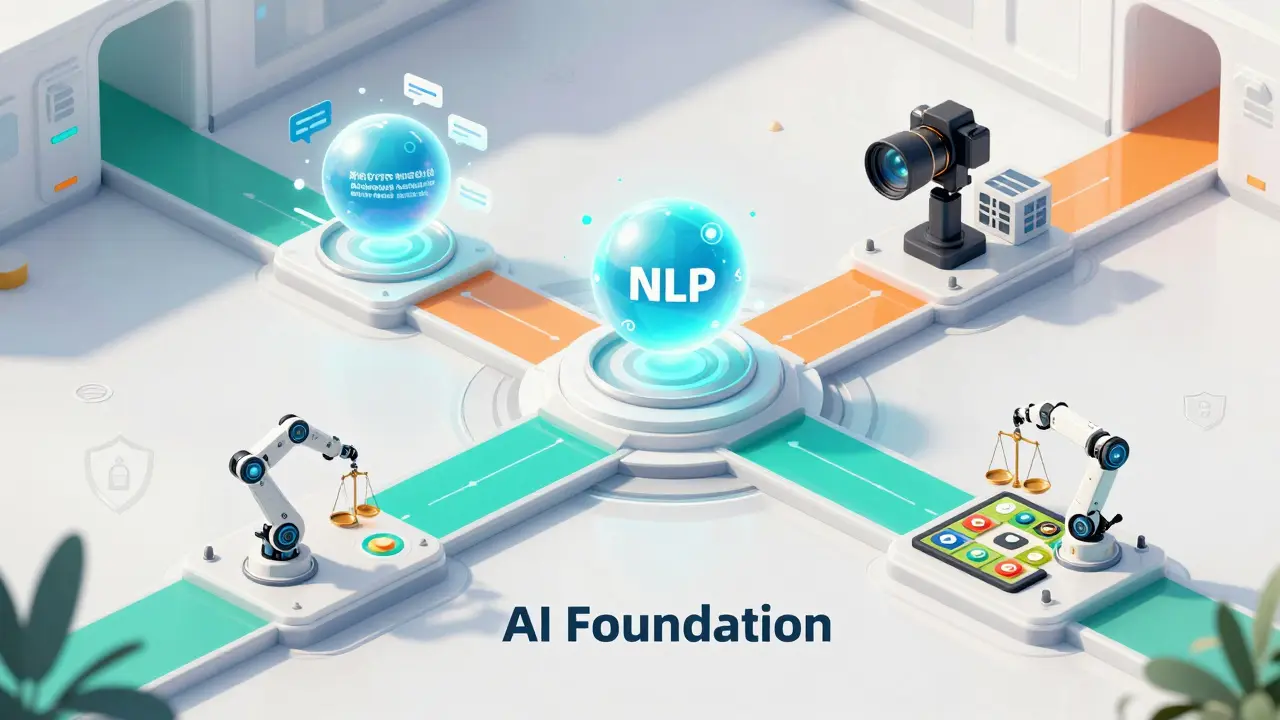
Step 5: Choose Your Specialization
AI is too broad to master everything. After gaining general proficiency, pick a specialization. This makes you hireable and allows you to dive deeper into specific challenges.
| Specialization | Key Technologies | Typical Applications | Difficulty Level |
|---|---|---|---|
| Natural Language Processing (NLP) | Hugging Face, Transformers, spaCy | Chatbots, sentiment analysis, translation | High |
| Computer Vision | OpenCV, YOLO, Detectron2 | Image recognition, medical imaging, autonomous driving | Medium |
| Reinforcement Learning | Gymnasium, Stable Baselines3 | Robotics, game AI, resource optimization | Very High |
| MLOps | Docker, Kubernetes, MLflow | Model deployment, monitoring, CI/CD for AI | Medium |
If you love language, go into NLP. The rise of Large Language Models (LLMs) has made this the hottest area. Learn fine-tuning techniques like LoRA and prompt engineering. If you prefer visuals, Computer Vision offers tangible results in healthcare and manufacturing. Reinforcement Learning is harder but opens doors in robotics and strategy games. MLOps is crucial for companies trying to scale AI solutions. Pick one and become known for it.
Step 6: Build and Deploy Real Projects
This is the most critical step. Watching videos gives you passive knowledge. Building projects gives you active expertise. Employers don’t care about your certificates; they care about what you’ve built.
Create a portfolio of three substantial projects:
- An End-to-End Application: Build a web app that uses an AI model. Use FastAPI to create an API endpoint, wrap it in a Docker container, and deploy it on AWS or Azure. Include a frontend with Streamlit or React.
- A Data Pipeline: Show you can handle data at scale. Ingest data from an API or database, preprocess it, train a model, and schedule retraining with Airflow or Prefect.
- A Research Replication: Pick a recent paper from arXiv and try to reproduce its results. Document your struggles and successes. This shows you can read technical literature and implement novel ideas.
Put your code on GitHub. Write clear README files explaining the problem, your approach, and how to run the code. Add comments and documentation. Treat your GitHub profile as your resume. In 2026, a clean, well-documented repository is worth more than five generic online certificates.
Step 7: Stay Current and Ethical
AI moves fast. What was state-of-the-art six months ago might be obsolete today. Commit to continuous learning. Follow key researchers on Twitter/X, subscribe to newsletters like The Batch by Andrew Ng, and read papers on arXiv daily.
Also, pay attention to ethics. AI systems can perpetuate biases, invade privacy, and cause harm. As you build, ask yourself: Who could be harmed by this model? Is my data representative? Can I explain my model’s decisions? Understanding ethical implications isn’t just nice-it’s becoming a legal requirement in many regions. Incorporate fairness checks and explainability tools like SHAP or LIME into your workflow from day one.
Frequently Asked Questions
How long does it take to master AI?
There is no fixed timeline. For someone with a programming background, reaching job-ready competency typically takes 6 to 12 months of dedicated study (10-15 hours per week). Mastery, implying deep expertise and the ability to innovate, usually requires 3-5 years of professional experience. Consistency matters more than intensity.
Do I need a degree in mathematics to learn AI?
No, you do not need a formal degree. However, you must self-study the core mathematical concepts mentioned earlier: linear algebra, calculus, and statistics. Many successful practitioners come from computer science, physics, or even non-STEM backgrounds. The key is understanding the intuition behind the math, not just memorizing formulas.
Is Python still the best language for AI in 2026?
Yes, Python remains the dominant language due to its vast ecosystem of libraries like PyTorch, TensorFlow, and scikit-learn. While languages like Rust are gaining traction for high-performance inference engines, Python is still the primary language for model development, research, and prototyping. Knowing Python is non-negotiable for most AI roles.
Should I focus on Deep Learning or Machine Learning first?
Start with classical Machine Learning. It provides a stronger foundation for understanding data preprocessing, model evaluation, and algorithmic behavior. Deep Learning is essentially a subset of Machine Learning. Understanding simpler models helps you appreciate when and why to use complex neural networks. Jumping straight into deep learning often leads to poor practices and wasted compute resources.
What are the best free resources for learning AI?
Excellent free resources include Andrew Ng’s Machine Learning Specialization on Coursera (audit mode), Fast.ai for practical deep learning, and the official PyTorch tutorials. For math, Khan Academy and 3Blue1Brown on YouTube are invaluable. Always supplement video content with hands-on coding exercises to reinforce learning.
How important is MLOps for beginners?
MLOps is increasingly important. While you can start by focusing on model building, understanding deployment, version control for data (DVC), and containerization (Docker) will make you significantly more employable. Companies need engineers who can ship models to production, not just those who can achieve high accuracy in a notebook. Start learning basic Docker and API creation early in your journey.