Python in AI: Why It Remains the Gold Standard for Innovation in 2026

It is hard to ignore the elephant in the room when you open a GitHub repository for any serious artificial intelligence project. You will almost certainly see .py files. Whether it is a startup building a new large language model or a researcher at MIT optimizing computer vision algorithms, Python is the dominant programming language for artificial intelligence and machine learning development. But why? Is it just because everyone else is doing it, or is there something fundamentally superior about how Python handles complex data structures?
The short answer is that Python is not necessarily the fastest language under the hood. C++ and Rust often beat it in raw execution speed. However, Python wins on developer velocity, ecosystem maturity, and ease of integration. In 2026, with the rise of agentic AI and multimodal models, the ability to prototype quickly matters more than ever. This article breaks down exactly why this combination works, which libraries you need to know, and how to avoid common pitfalls.
The Ecosystem Advantage: More Than Just Syntax
When we talk about Python in AI, we are really talking about its ecosystem. The language itself is simple, but the libraries built on top of it form a powerful stack. Imagine trying to build a house without pre-fabricated walls or windows. That is what coding AI from scratch in a lower-level language feels like. Python gives you those prefabs.
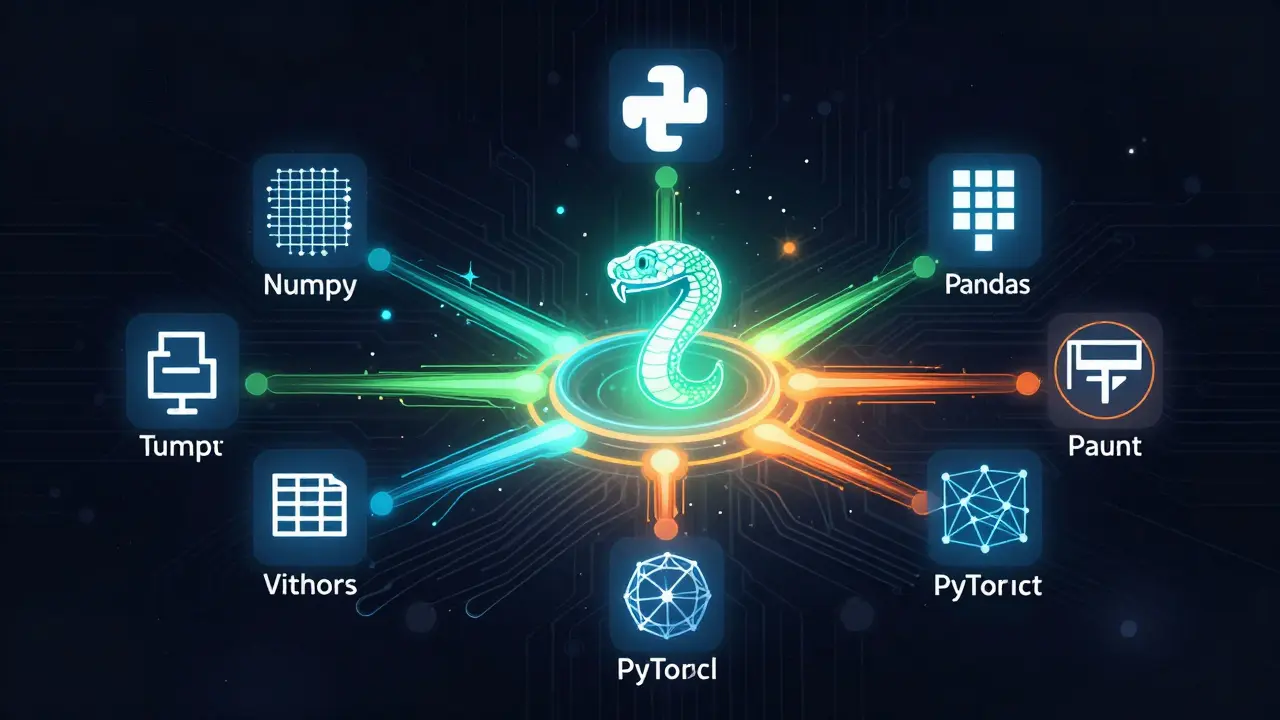
The core of this ecosystem relies on a few key players. First, there is NumPy is a fundamental library for numerical computing in Python, providing support for large, multi-dimensional arrays and matrices. NumPy handles the heavy lifting of linear algebra operations efficiently by delegating calculations to optimized C code. Then you have Pandas is a data manipulation and analysis library that provides data structures like DataFrames for structured data handling. Pandas makes cleaning messy real-world data-something that takes up 80% of an AI engineer's time-manageable.
But the real magic happens with deep learning frameworks. For years, TensorFlow was an end-to-end open-source platform for machine learning developed by Google. dominated the industry due to its strong production capabilities. Today, however, PyTorch is a machine learning framework based on the Torch library, known for its dynamic computation graph and research-friendly design. has become the standard for research and increasingly for production. Its dynamic graph allows developers to change network architectures on the fly, which is crucial when experimenting with new neural network designs. As of 2026, PyTorch’s integration with cloud providers and its support for distributed training have solidified its position as the go-to choice for most AI teams.
Why Developers Choose Python Over Alternatives
You might wonder why languages like Java, Go, or even Julia haven't stolen the crown. Each has merits. Julia, for instance, was designed specifically for high-performance numerical analysis and can rival Python in speed while maintaining readability. However, adoption creates a network effect. When every major AI paper publishes its code in Python, and every new GPU driver supports Python bindings first, the barrier to entry for using anything else becomes too high.
Consider the concept of "glue code." Python excels at connecting different systems. An AI application rarely runs in isolation. It needs to pull data from a SQL database, process images using OpenCV, run inference on a GPU via CUDA, and serve results through a REST API. Python has mature libraries for all these tasks. Switching between languages requires complex inter-process communication, which adds latency and debugging headaches. Staying in Python keeps the workflow smooth.
| Language | Primary Strength | Ecosystem Maturity | Performance (Raw Speed) | Best Use Case |
|---|---|---|---|---|
| Python | Rapid Prototyping & Library Support | Very High | Moderate (optimized via C extensions) | End-to-End AI Development |
| C++ | Low-Level Control & Speed | High | Very High | Core Framework Implementation |
| Julia | Numerical Performance | Growing | High | Scientific Computing & Heavy Math |
| JavaScript | Web Integration | Moderate | Moderate | Browser-Based AI Apps |
Key Libraries Every AI Developer Should Know
To leverage Python effectively, you need to master the right tools. Here is a breakdown of the essential libraries that power modern AI applications.
- Hugging Face Transformers: This library has become synonymous with natural language processing (NLP). It provides thousands of pre-trained models for tasks like text generation, translation, and sentiment analysis. In 2026, it supports not just text but also audio and vision models, making it a unified hub for multimodal AI.
- Scikit-learn: While deep learning gets all the attention, traditional machine learning remains vital. Scikit-learn offers simple and efficient tools for data mining and data analysis. It is perfect for classification, regression, and clustering tasks where massive datasets aren't required.
- JAX: Developed by Google, JAX combines NumPy-style syntax with automatic differentiation and JIT compilation. It is gaining traction among researchers who need extreme performance and flexibility for custom gradient computations.
- LangChain: As AI agents become more common, LangChain helps developers build applications powered by large language models. It manages context, memory, and tool use, allowing LLMs to interact with external APIs and databases.
Performance Optimization: Making Python Fast Enough
Critics often point out that Python is slow. They are right-if you write naive Python loops. But no one writes naive loops in production AI code. The trick is to push the heavy computation into compiled libraries. When you call a function in NumPy or PyTorch, the actual math happens in C, C++, or Fortran. Python acts as the conductor, not the orchestra.
If you still hit bottlenecks, there are several strategies to optimize your code. First, consider using Numba is a just-in-time compiler for Python that translates a subset of Python and NumPy code into fast machine code. Numba can speed up numerical functions by 10x or more without changing your code significantly. Another option is Cython, which allows you to write C extensions for Python directly. For deep learning, ensuring your tensors are on the GPU is the single biggest performance win. Always check if your operations are leveraging hardware acceleration.
Additionally, asynchronous programming with asyncio can help manage I/O-bound tasks, such as fetching data from multiple sources simultaneously. While this doesn't speed up CPU-bound calculations, it prevents your application from sitting idle while waiting for network responses.
Real-World Applications of Python in AI
Let’s look at how this plays out in practice. Take healthcare diagnostics. A hospital wants to detect anomalies in MRI scans. They use Python to preprocess the images (using OpenCV), feed them into a convolutional neural network (built with PyTorch), and store the results in a database (via SQLAlchemy). The entire pipeline is written in Python, making it easy for data scientists, backend engineers, and DevOps teams to collaborate.
In finance, algorithmic trading firms use Python for strategy backtesting. Libraries like Backtrader allow traders to simulate their strategies against historical data quickly. Once a profitable strategy is found, it might be rewritten in C++ for live execution to minimize latency, but the research phase is almost exclusively Python.
Even in robotics, Python is ubiquitous. ROS (Robot Operating System) uses Python extensively for scripting robot behaviors and integrating sensors. Companies like Boston Dynamics rely on Python for high-level control logic, while lower-level motor control is handled by faster languages.

Future Trends: Where Is Python Heading?
As we move further into 2026, Python continues to evolve. One significant trend is the integration of AI-assisted coding tools. Tools like GitHub Copilot are becoming smarter at understanding Python-specific idioms and library patterns, boosting developer productivity even further.
Another area of growth is edge AI. Running AI models on devices like smartphones and IoT sensors requires lightweight frameworks. MicroPython and CircuitPython are bringing Python’s simplicity to microcontrollers, enabling AI capabilities in constrained environments. This democratization means that AI is no longer confined to server rooms; it is everywhere.
Finally, the community is focusing on sustainability. Training large models consumes enormous amounts of energy. Python libraries are incorporating metrics to track carbon footprints, helping developers make greener choices. This shift reflects a broader awareness of the environmental impact of AI innovation.
Common Pitfalls to Avoid
Despite its advantages, Python has traps. One common mistake is ignoring virtual environments. Using venv or Conda ensures that dependencies do not conflict between projects. Another pitfall is over-engineering. Python encourages rapid development, which can lead to messy code if not disciplined. Adopting best practices like type hinting and linting with tools like Flake8 or Black keeps your codebase maintainable.
Also, be cautious with global state in multi-threaded applications. Python’s Global Interpreter Lock (GIL) limits true parallelism in multi-threaded CPU-bound tasks. For such cases, use multiprocessing instead of threading, or offload work to GPU-accelerated libraries.
Is Python the only language used in AI?
No, Python is not the only language. C++ is widely used for implementing the core engines of AI frameworks like TensorFlow and PyTorch due to its performance. Julia is gaining popularity for scientific computing, and JavaScript is used for deploying AI models in web browsers. However, Python remains the primary interface for most developers due to its extensive libraries and ease of use.
Should I learn PyTorch or TensorFlow in 2026?
For most new learners and researchers, PyTorch is the recommended choice. It has a more intuitive API and is the standard in academic research. TensorFlow is still relevant, particularly in enterprise environments and for specific deployment scenarios using TensorFlow Lite or TensorFlow.js. However, PyTorch's momentum is stronger in the current landscape.
How does Python handle big data?
Python handles big data through libraries like Pandas for smaller datasets and Dask or Apache Spark (via PySpark) for larger, distributed datasets. These tools allow you to process data that exceeds your machine's memory by distributing computations across clusters. Additionally, PyArrow provides efficient columnar storage formats for fast data interchange.
Can Python run on mobile devices?
Yes, Python can run on mobile devices, though it is less common than native languages like Swift or Kotlin. Projects like Kivy and BeeWare allow you to build cross-platform mobile apps with Python. For AI specifically, models trained in Python can be converted to formats like ONNX or TensorFlow Lite to run efficiently on iOS and Android devices.
What is the role of the GIL in Python AI development?
The Global Interpreter Lock (GIL) prevents multiple threads from executing Python bytecodes simultaneously, which can limit CPU-bound parallelism. However, in AI development, most heavy computations are offloaded to C/C++ libraries (like NumPy or PyTorch) that release the GIL during execution. Therefore, the GIL rarely impacts the performance of well-written AI applications. For true parallelism, use multiprocessing or asynchronous I/O.