Python and AI: Making the Complex Simple

When you hear "artificial intelligence," what comes to mind? Robots taking over the world? Self-driving cars? Chatbots that sound like humans? The truth is, AI doesn’t need to be complicated. At its core, AI is just math and patterns - and Python makes it easy to work with.
Python isn’t just popular for AI. It’s the default language for most AI projects today. Why? Because it cuts through the noise. You don’t need to write hundreds of lines of code to train a model that recognizes cats in photos. With Python, you can do it in under 20. That’s not magic - it’s design.
Why Python Dominates AI
Python didn’t become the go-to language for AI by accident. It was built for clarity, not complexity. Think of it like a Swiss Army knife that actually works the way you expect. Need to load data? Use pandas. Need to visualize it? matplotlib or seaborn do the job. Need to train a neural network? TensorFlow and PyTorch handle the heavy lifting - and you barely notice it.
Take image classification. In other languages, you’d need to manage memory, compile code, and handle low-level operations. In Python? You write:
from tensorflow.keras import layers
model = layers.Sequential([
    layers.Conv2D(32, (3,3), activation='relu'),
    layers.MaxPooling2D(),
    layers.Flatten(),
    layers.Dense(10, activation='softmax')
])
model.compile(optimizer='adam', loss='sparse_categorical_crossentropy')
That’s it. You’ve built a CNN - a convolutional neural network - that can learn to recognize objects. No PhD required. No C++ pointers. Just clean, readable code.
Real-World AI, Built in Python
Companies aren’t using Python because it’s trendy. They’re using it because it works. Instagram runs on Python. Netflix uses it to recommend shows. Spotify builds its music discovery engine with Python. Even NASA uses Python to analyze satellite data.
Here’s a real example from Melbourne: a local startup called GreenTrack used Python to build an AI that predicts energy use in homes. They didn’t hire a team of AI engineers. They had one data scientist, a laptop, and a few Python libraries: scikit-learn, numpy, and joblib. Within six weeks, they had a model that reduced energy waste by 18% in test homes. No fancy hardware. No cloud bills. Just Python.
Tools That Make AI Accessible
Python’s power in AI comes from its ecosystem. You don’t need to build everything from scratch. Here’s what most people use:
- scikit-learn - For classic machine learning: decision trees, SVMs, clustering. Perfect for tabular data like sales records or survey responses.
- TensorFlow and PyTorch - For deep learning. Think image recognition, speech processing, or large language models. PyTorch is favored by researchers; TensorFlow by engineers building production systems.
- pandas - Loads and cleans messy data. Real-world data is messy. Pandas turns chaos into order.
- NumPy - The math engine behind most AI. It handles arrays and matrices faster than plain Python.
- OpenCV - For computer vision. Face detection, motion tracking, object counting - all doable in under 10 lines.
These aren’t just tools. They’re building blocks. You can stack them like LEGO. Want to predict house prices? Use pandas to load data, scikit-learn to train a model, and joblib to save it. Done.
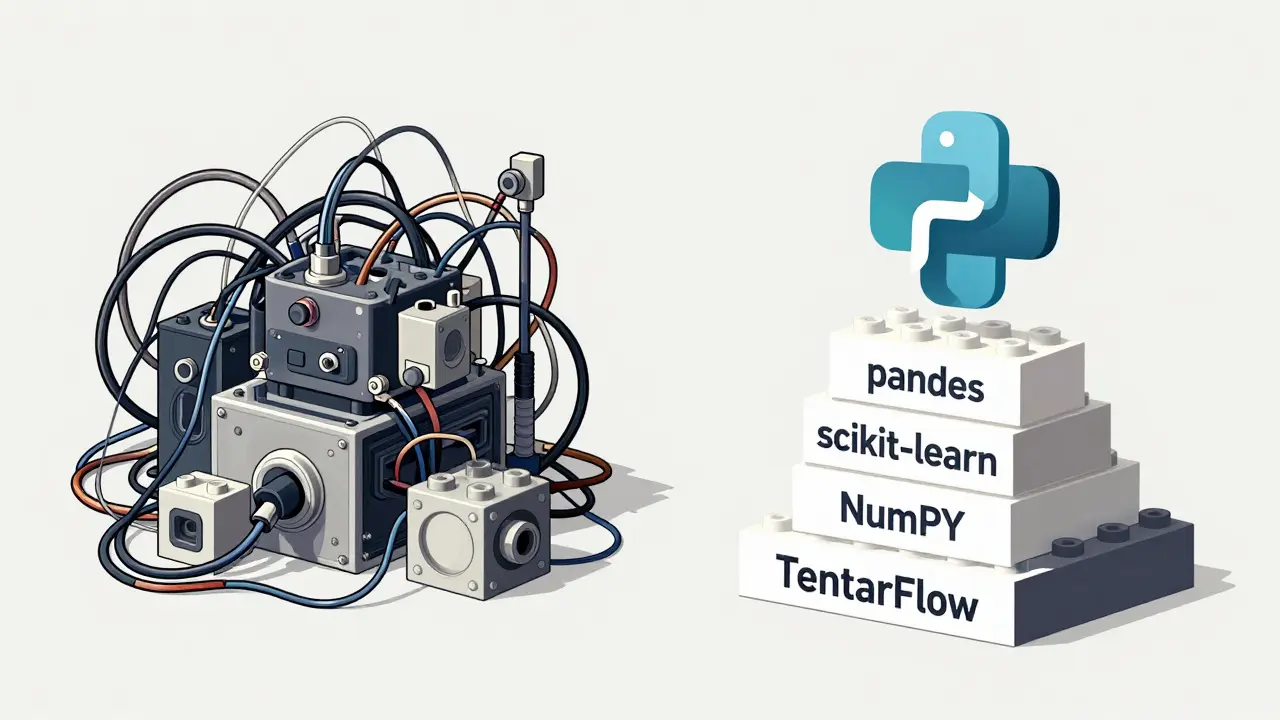
From Zero to AI in 3 Steps
You don’t need to be a programmer to start. Here’s how to begin:
- Install Python - Download Python 3.12 from python.org. It’s free. Install
pip(it comes with Python). - Install the essentials - Run this in your terminal:
pip install pandas scikit-learn numpy matplotlib jupyter - Try a real project - Load the iris dataset (built into scikit-learn). Train a model to classify flower types. It takes 10 minutes. You’ll get 95% accuracy. No joke.
That’s your first AI model. No PhD. No $10,000 GPU. Just Python.
What AI in Python Can Actually Do Today
Let’s get specific. Here’s what real people are doing with Python and AI right now:
- Automating customer service - A small e-commerce store in Adelaide uses Python to auto-reply to 80% of customer emails. They trained a model on past replies. Now, their support team handles only the hard cases.
- Detecting fraud - A credit union in Brisbane built a Python model that flags suspicious transactions. It reduced false positives by 40% compared to their old rules-based system.
- Monitoring crop health - A farm in the Murray Valley uses drones and Python to analyze satellite images. The AI spots disease before farmers can see it.
- Translating sign language - A university project in Sydney uses a webcam and Python to convert hand gestures into text in real time. It’s not perfect, but it works.
These aren’t sci-fi experiments. They’re everyday tools. And they all run on Python.
Common Myths About Python and AI
People think AI needs:
- Big teams - Nope. One person with Python can build a working AI. Many startups started that way.
- Expensive hardware - Not anymore. You can train small models on a $1,000 laptop. Cloud services like Google Colab give you free GPU access.
- Math genius skills - You don’t need to derive the backpropagation algorithm. Libraries do it for you. You just need to understand inputs and outputs.
- Years of experience - You can build your first AI in a weekend. The barrier to entry has never been lower.
The real challenge isn’t the code. It’s asking the right question. What problem are you trying to solve? Python will handle the rest.

Where Python Falls Short - And What to Do
Python isn’t perfect. For ultra-high-speed systems - like trading algorithms that run in microseconds - C++ or Rust are faster. For mobile apps, you’ll need to wrap your Python model in iOS or Android code.
But here’s the thing: most AI projects don’t need microseconds. They need reliability, speed to market, and easy updates. Python wins there. And if you need speed later? You can always port the model to C++ - but you’ll still use Python to build and test it first.
Think of Python as your prototype engine. It gets you from idea to working product fast. Then you optimize.
Getting Started: What to Learn Next
If you’re new, here’s a realistic path:
- Learn Python basics - variables, loops, functions. Use free resources like Python for Everybody on Coursera.
- Learn pandas - how to load, filter, and clean data. This is 70% of AI work.
- Try scikit-learn - build a model that predicts something simple: movie ratings, house prices, or weather.
- Move to Jupyter Notebooks - they let you mix code, text, and visuals. Perfect for learning.
- Try a Kaggle competition - start with "Titanic: Machine Learning from Disaster." It’s beginner-friendly.
Don’t aim for perfection. Aim for progress. Your first model might be wrong. That’s fine. The second one will be better.
| Tool | Best For | Learning Curve | Used By |
|---|---|---|---|
| scikit-learn | Tabular data, classic ML | Low | Startups, banks, healthcare |
| PyTorch | Research, custom neural nets | Moderate | Universities, AI labs |
| TensorFlow | Production systems, mobile AI | Moderate | Google, Uber, Amazon |
| pandas | Data cleaning, exploration | Very Low | Every data team |
| OpenCV | Computer vision, image analysis | Moderate | Drones, security, manufacturing |
Final Thought: AI Isn’t About Complexity
The biggest mistake people make is thinking AI has to be hard. It doesn’t. Python took the complexity out of AI and gave it back to people. You don’t need to be a genius. You just need to start.
Start small. Try one model. Break it. Fix it. Try again. That’s how real AI gets built - not in labs with billion-dollar budgets, but in quiet rooms, on laptops, with Python.
Do I need to know advanced math to use Python for AI?
No. You don’t need to understand calculus or linear algebra deeply. Libraries like scikit-learn and TensorFlow handle the math for you. What matters is knowing how to prepare data, interpret results, and choose the right tool. Think of it like driving a car - you don’t need to know how the engine works to use it.
Can I use Python for AI on a regular laptop?
Yes. For learning and small projects, even a basic laptop with 8GB RAM works fine. You can train models on datasets with thousands of rows without issues. For larger models (like image or language models), use Google Colab - it gives you free access to GPUs. No hardware upgrade needed.
Is Python the only language for AI?
No. R, Java, and Julia are used in niche areas. But Python has the largest community, the most libraries, and the best documentation. If you’re starting now, Python is the fastest path to results. It’s the standard for a reason.
How long does it take to build your first AI model?
With Python, you can build a working model in under an hour. Start with a dataset like house prices or flower types. Load it with pandas, train with scikit-learn, and make a prediction. You’ll have something that works - even if it’s not perfect. That’s the power of Python.
What’s the next step after learning Python for AI?
Build something real. Pick a problem you care about - like predicting your monthly expenses, tracking your sleep patterns, or sorting your photos. Use Python to solve it. Then share it. The best way to learn isn’t by reading - it’s by doing, failing, and trying again.