Mastering Coding Skills: A Practical Path to Success
Coding Project Time Estimator
Based on the article's advice: Consistency beats intensity
Most people think mastering coding skills means spending years in front of a screen, memorizing syntax, and chasing the latest framework. That’s not true. The real secret isn’t how much you know-it’s how you learn, what you build, and how you think. Coding isn’t magic. It’s a craft. And like any craft, it’s built one small win at a time.
Start with the right mindset, not the right language
You don’t need to pick the "best" programming language to succeed. Python? JavaScript? Java? They’re all tools. What matters is that you pick one and stick with it until you can solve real problems with it. A 2024 Stack Overflow survey showed that developers who stayed with one language for at least six months before switching were 40% more likely to land their first job than those who jumped between languages every few weeks.
Start with Python if you’re new. It’s readable, forgiving, and used everywhere-from automating spreadsheets to training AI models. But don’t fall into the trap of thinking Python is "easy" and everything else is "hard." The difference between beginners and skilled coders isn’t the language-it’s their ability to break problems down.
Build something real, even if it’s small
Reading tutorials won’t make you a coder. Building things will. You don’t need to create the next TikTok. Start with something that solves a problem you actually have.
Here are three simple projects anyone can build in under a week:
- A script that renames 100 photos in your downloads folder in alphabetical order
- A to-do list app that saves tasks to a file (no database needed)
- A weather checker that texts you if it’s going to rain tomorrow
These aren’t flashy. But they teach you how to read documentation, handle errors, and debug when things break. That’s 80% of real-world coding.
And here’s the key: finish them. Don’t get stuck in tutorial hell. Complete projects-even ugly ones-build confidence and muscle memory. A half-finished app teaches you less than a finished one that crashes sometimes.
Learn to read code, not just write it
Most beginners think coding is about typing fast. It’s not. It’s about reading slowly. The best coders spend more time reading other people’s code than writing their own.
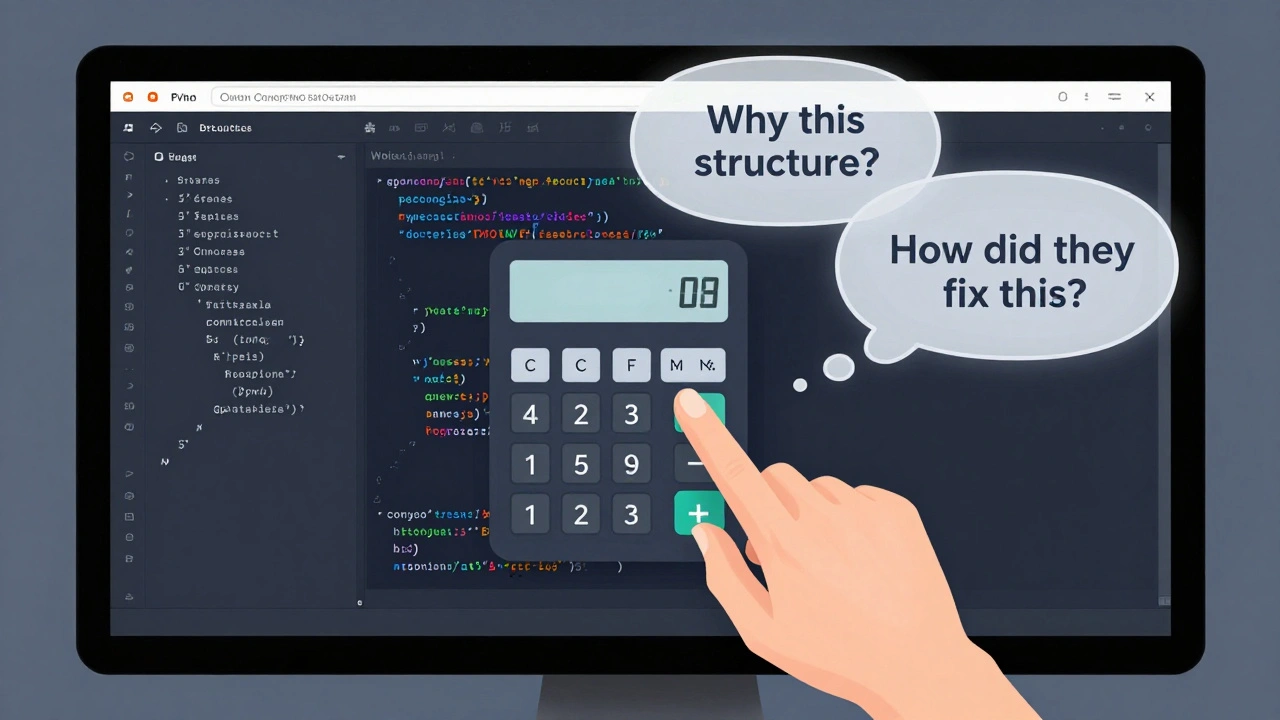
Open-source projects on GitHub are free classrooms. Find a simple Python project-like a calculator or a note-taking app-and read through it. Don’t copy it. Ask yourself:
- Why did they structure it this way?
- What’s the purpose of each function?
- Where would you improve it?
Look at the commit history. See how the project evolved. Notice how the author fixed bugs. That’s where the real lessons live-not in tutorials, but in the messy, real-world process of building something over time.
Embrace the struggle-your brain is learning
Feeling stuck? Good. That’s your brain growing. Every coder hits walls. The difference between those who quit and those who keep going isn’t talent-it’s how they handle frustration.
When you get an error message, don’t panic. Read it. Copy it. Paste it into Google. You’ll find answers 90% of the time. But here’s the trick: don’t just copy the fix. Understand why it worked. Was it a missing colon? A typo in a variable name? A wrong file path?
Keep a simple log: write down the error, what you tried, and what finally worked. After 10 of these, you’ll start recognizing patterns. That’s when coding stops feeling random and starts feeling logical.
Consistency beats intensity
You don’t need to code for eight hours a day. You need to code for 30 minutes every day.
A 2023 study from the University of Queensland tracked 200 beginners over six months. Those who coded 30 minutes daily improved 3x faster than those who did 4-hour marathons once a week. Why? Because your brain needs time to process what you’ve learned. Short, regular practice builds neural pathways. Long, irregular sessions just create noise.
Make it part of your routine. Code while your coffee brews. Code before you check your phone in the morning. Code for 20 minutes after dinner. It doesn’t matter when. What matters is that you show up.
Learn to ask better questions
Asking for help is part of being a coder. But not all questions are created equal.
Bad question: "My code doesn’t work. Help?" Good question: "I’m trying to read a CSV file in Python and getting a KeyError: 'name'. I’ve checked the file-it has a 'name' column. Here’s my code: [paste]. I’ve tried checking the column names with df.columns and printing them, but they still don’t match. What am I missing?"
The second question gives context, shows effort, and makes it easy for someone to help. That’s how you get real answers. And when you get them, you’ll remember them.
Build a portfolio-not a resume
Employers don’t care how many courses you’ve taken. They care what you’ve built.
Put your projects online. Use GitHub. Even if your code isn’t perfect. Add a README file explaining what the project does, how to run it, and what you learned. That’s your portfolio. That’s your proof.
One person I know landed a job at a Brisbane startup because they built a simple app that helped local farmers track crop prices. It wasn’t fancy. But it solved a real problem. That’s what stood out.
Code isn’t just a skill-it’s a superpower
Mastering coding skills opens doors you didn’t even know existed. You can automate boring tasks at work. You can build tools for your side hustle. You can fix things yourself instead of waiting for someone else.
It’s not about becoming a software engineer overnight. It’s about becoming someone who can make things happen. That’s the real path to success.
What’s next?
Start today. Pick one small project. Code for 30 minutes. Finish it. Then do it again tomorrow. That’s how mastery happens-not in grand plans, but in quiet, consistent action.
Do I need a computer science degree to master coding skills?
No. Most successful developers today are self-taught. What matters is your ability to solve problems, not your diploma. Companies like Google, Apple, and IBM now hire based on skills tests and project portfolios, not degrees. Focus on building and demonstrating your abilities.
How long does it take to become proficient in coding?
Most people can build simple, useful applications in 3 to 6 months with consistent daily practice. Becoming truly proficient-able to tackle complex projects and work in a team-usually takes 1 to 2 years. There’s no rush. Progress is measured in projects completed, not months spent.
What’s the most common mistake beginners make?
Jumping between languages and frameworks too quickly. Beginners often think they need to learn React, Node.js, Python, SQL, Docker, and Kubernetes all at once. That’s overwhelming. Master one language, build a few projects, then expand. Depth before breadth.
Is it too late to start learning to code if I’m over 30?
Absolutely not. The average age of a new software developer entering the workforce in 2025 is 34. Many people switch careers after 40. What matters is your willingness to learn, not your age. Coding rewards persistence, not youth.
Should I learn to code for AI or just stick to web development?
Start with the basics first. Whether you want to build websites, automate tasks, or train AI models, you need the same foundation: variables, loops, functions, and debugging. Once you’re comfortable with one language, you can specialize. Python works for both web dev and AI. You don’t need to choose right away.
How do I stay motivated when coding feels boring?
Work on something that matters to you. If you hate spreadsheets, build a tool that automates them. If you love music, make a playlist organizer. If you’re into fitness, track your workouts with code. When your project connects to your interests, the work stops feeling like a chore and starts feeling like play.