Learning AI: Why It’s the Most Valuable Skill for Your Career in 2026

You don’t need a PhD to survive the next decade. You just need to know how to talk to machines. That sounds like science fiction, but if you’re sitting there wondering whether learning AI is actually worth your time, let me give you the short answer: yes. In fact, it’s probably the most important investment you can make in your career right now.
We are living through a shift that feels bigger than the internet boom of the late 90s. Back then, knowing HTML made you indispensable. Today, understanding how to leverage generative models, automate workflows, and interpret data insights is the new baseline. If you ignore this, you aren’t just falling behind; you’re becoming obsolete. But here’s the good news: you don’t have to become a software engineer to benefit. You just have to become fluent.
Why AI Fluency Is the New Literacy
Let’s clear up a misconception first. When people say "learn AI," they often imagine staring at lines of Python code until their eyes bleed. That’s one path, sure, but it’s not the only one. For most professionals, AI fluency means something different. It means understanding what these tools can do, where they fail, and how to integrate them into your daily workflow without losing your mind.
Think about it. A marketing manager who uses AI to draft ten variations of an email campaign in seconds has a massive advantage over someone writing each one by hand. A financial analyst who uses predictive modeling to spot trends before they hit the headlines is making better decisions than someone relying on gut feeling alone. The skill isn’t coding; it’s problem-solving with enhanced capabilities.
In 2026, the gap between those who use AI and those who don’t is widening rapidly. Companies are no longer asking, "Do you know AI?" They’re asking, "How do you use AI to get more done?" If you can’t answer that confidently, you’re already at a disadvantage.
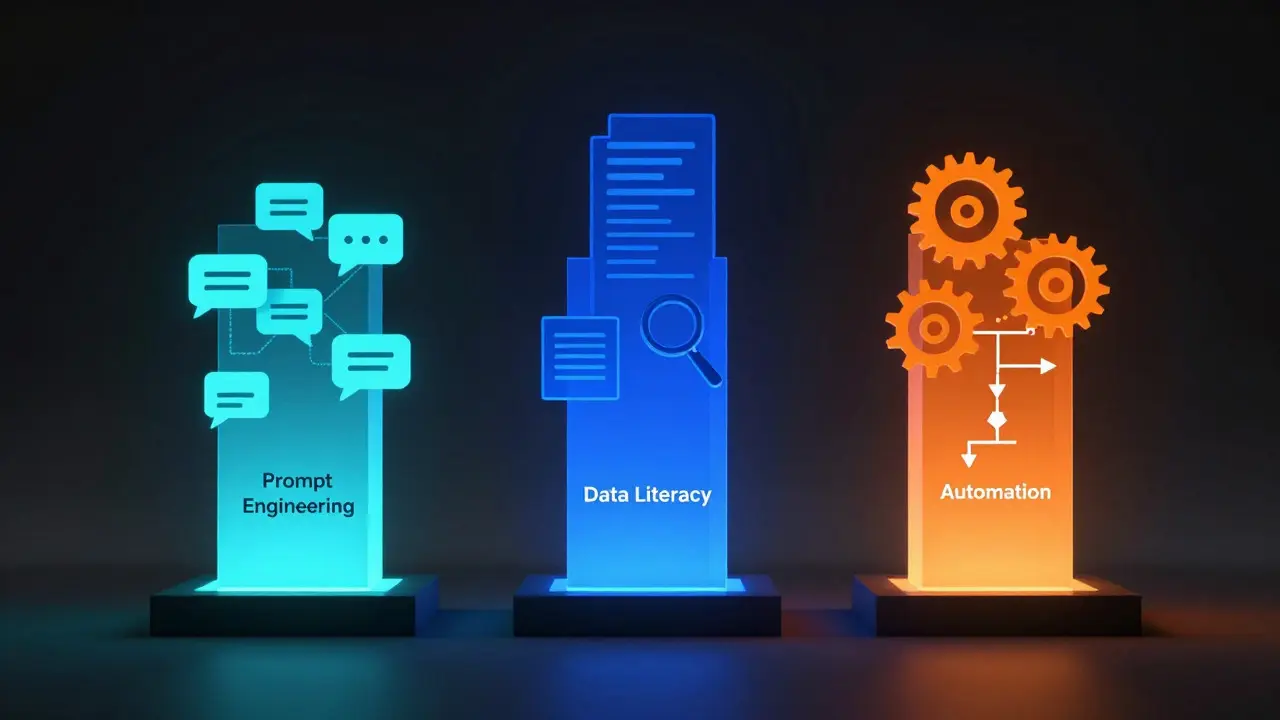
The Three Pillars of Practical AI Skills
So, where do you start? You don’t need to learn everything. Focus on three core areas that will give you the biggest return on investment.
1. Prompt Engineering and Interaction
This is the bread and butter of modern AI usage. It’s the art of communicating clearly with large language models (LLMs). Bad prompts get bad results. Good prompts get gold. Learning how to structure your requests, provide context, and iterate on outputs is a skill that takes weeks to master, not years. It applies to every industry, from law to healthcare to creative writing.
2. Data Literacy and Interpretation
AI thrives on data. You don’t need to be a statistician, but you do need to understand basic concepts like bias, correlation vs. causation, and data quality. If you feed garbage into an AI model, you’ll get sophisticated garbage out. Knowing how to clean, structure, and question your data is crucial. This helps you avoid the embarrassing mistake of presenting AI-generated insights that are statistically meaningless or ethically problematic.
3. Automation and Workflow Integration
This is where the real magic happens. It’s about connecting AI tools to your existing processes. Maybe it’s using a tool like Zapier or Make.com to automatically summarize emails, or using Python scripts to scrape and analyze web data. The goal is to remove repetitive tasks from your plate so you can focus on high-value work. This doesn’t require deep coding knowledge-just a willingness to experiment with low-code and no-code platforms.
| Skill Level | Focus Area | Time to Learn | Best For |
|---|---|---|---|
| Beginner | Prompting & Basic Tools | 2-4 Weeks | All Professionals |
| Intermediate | Data Literacy & No-Code Automation | 2-3 Months | Analysts, Managers |
| Advanced | Custom Models & API Integration | 6+ Months | Developers, Data Scientists |
Breaking Down the Technical Barrier
I know what you’re thinking. "I’m not technical." Good. Neither was I when I started. The barrier to entry has never been lower. Platforms like ChatGPT is a conversational AI developed by OpenAI that assists users with writing, analysis, and coding tasks. and Claude is an AI assistant created by Anthropic known for its nuanced reasoning and safety-focused design. allow anyone with an internet connection to access powerful intelligence. You don’t need to build the engine; you just need to know how to drive the car.
If you want to go deeper, Python is still the lingua franca of AI. But you don’t need to memorize syntax. There are countless resources designed for beginners. Sites like Kaggle offer free datasets and tutorials that walk you through building simple models step-by-step. You can learn enough Python in a few weekends to automate basic tasks or understand the logic behind machine learning algorithms.
The key is to start small. Pick one repetitive task in your job. Can AI help? Try it. Did it work? Great. Did it fail? Analyze why. This iterative process builds confidence and competence faster than any theoretical course ever could.
Navigating Ethics and Bias
Here’s the part nobody talks about enough: AI is not neutral. It reflects the data it was trained on, which means it inherits human biases. If you’re hiring, lending money, or diagnosing patients, you need to be aware of this. Learning AI isn’t just about technical skills; it’s about ethical responsibility.
Ask yourself: Who benefits from this output? Who might be harmed? Is the data representative? These questions are as important as the code itself. In 2026, regulatory frameworks like the EU AI Act are tightening, meaning companies are holding individuals accountable for how they deploy AI. Ignorance is no longer an excuse. Understanding bias mitigation strategies is a critical component of professional AI literacy.

Building Your Personal AI Curriculum
You don’t need a degree. You need a plan. Here’s a simple roadmap to get you from zero to proficient:
- Week 1-2: Play Around. Sign up for major LLMs. Experiment with different prompts. See what they can and can’t do. Break them. Fix them.
- Week 3-4: Automate One Task. Identify a boring, repetitive task. Find a tool or script to automate it. Use no-code platforms if needed.
- Month 2: Learn the Basics of Data. Take a free online course on data literacy. Understand terms like mean, median, standard deviation, and bias.
- Month 3: Dive Deeper. If you’re interested in the technical side, start learning Python basics. If not, explore advanced prompt engineering techniques and AI-specific tools for your industry.
- Ongoing: Stay Curious. AI moves fast. Follow thought leaders, read newsletters, and keep experimenting. What works today might be obsolete in six months.
Remember, consistency beats intensity. Spending thirty minutes a day learning is far more effective than cramming for a weekend.
The Future-Proof Mindset
Ultimately, learning AI is about adopting a growth mindset. It’s about being comfortable with uncertainty and willing to adapt. The tools will change. The platforms will evolve. But the underlying principle remains the same: leverage technology to amplify your human potential.
Don’t wait for permission. Don’t wait for a formal training program. Start today. Ask an AI to help you write an email. Use it to brainstorm ideas. Let it summarize a long report. Each small interaction builds your intuition and comfort level. Before you know it, you’ll be looking back at the person who hesitated and wondering why they didn’t start sooner.
The digital age isn’t coming. It’s here. And AI is its heartbeat. Join the rhythm, or get left behind.
Do I need to know how to code to learn AI?
No, you don’t. While coding skills (like Python) are helpful for advanced roles, most professionals can benefit significantly from AI without writing a single line of code. Focus on prompt engineering, data literacy, and using no-code automation tools first.
How long does it take to become proficient in AI?
For basic proficiency in using AI tools effectively, expect 2-4 weeks of consistent practice. For intermediate skills involving data analysis and automation, plan for 2-3 months. Advanced technical skills may take 6 months or more depending on your background.
Is AI going to replace my job?
AI is unlikely to replace entire jobs, but it will replace tasks within jobs. The risk isn’t that AI will take your job; it’s that someone else using AI will. By learning AI, you position yourself as the person who leverages these tools, making you more valuable, not less.
What are the best free resources for learning AI?
Start with platforms like Kaggle for hands-on data projects, Coursera or edX for structured courses (many are free to audit), and official documentation from providers like OpenAI or Anthropic. YouTube channels dedicated to AI tutorials are also excellent for visual learners.
How do I ensure I’m using AI ethically?
Always verify AI outputs for accuracy and bias. Be transparent about using AI in your work. Avoid feeding sensitive personal data into public models. Stay informed about regulations like the EU AI Act and company-specific policies regarding AI usage.