How Artificial Intelligence is Transforming the Business World in 2026

It is July 2026, and if you have been paying attention to your inbox or your supply chain dashboard, you already know that Artificial Intelligence is no longer a futuristic concept sitting in a research lab. It is the engine running behind your customer service chat, the logic predicting your inventory needs, and the tool drafting your quarterly reports. The hype cycle has settled into reality. We are past the stage of asking if AI will change business; we are now dealing with the messy, profitable, and complex process of how it actually does.
The shift isn't just about speed. It is about decision-making. For decades, businesses relied on human intuition backed by historical data analysis that took weeks to compile. Today, Generative AI and Machine Learning systems process real-time variables to suggest actions before a problem even fully materializes. This article breaks down exactly where this technology is making the biggest impact, what pitfalls you need to avoid, and how companies are structuring themselves for this new era.
From Automation to Augmentation: The New Work Model
The early days of digital transformation were obsessed with replacing human labor with code. If a task was repetitive, we automated it. But the current wave of AI adoption is different. It is not about replacement; it is about augmentation. Think of it as giving every employee a super-powered assistant that never sleeps, knows the entire company database, and can draft emails in seconds.
In marketing departments, for example, copywriters are no longer staring at blank pages. They use Large Language Models (LLMs) to generate initial drafts of blog posts, ad copy, and product descriptions. A marketer who used to produce four articles a month might now oversee the production of forty, spending their time on strategy, tone adjustment, and factual verification rather than typing every word. This doesn't mean jobs are disappearing; it means the definition of the job is changing. The value shifts from creation to curation.
Similarly, in software development, engineers are using AI coding assistants to write boilerplate code, debug errors, and suggest optimizations. This allows developers to focus on architecture and complex logic problems. The result? Faster time-to-market and fewer mundane bugs. However, this requires a cultural shift. Managers must stop measuring output by lines of code written and start measuring it by problems solved.
Predictive Analytics: Seeing Around Corners
If generative AI is the creative muscle of modern business, predictive analytics is its brain. This is where Machine Learning algorithms shine. These systems ingest vast amounts of structured data-sales figures, weather patterns, social media sentiment, economic indicators-and find correlations that humans would miss.
Consider retail. In 2015, a retailer might have looked at last year’s Christmas sales to decide how much stock to buy this year. In 2026, an AI system analyzes local weather forecasts, trending fashion topics on social media, competitor pricing changes, and even traffic patterns near specific stores. It predicts demand with terrifying accuracy. This reduces waste from overstocking and prevents lost revenue from understocking.
Finance is another sector transformed by this capability. Fraud detection systems no longer rely on simple rules like "flag transactions over $10,000." Instead, they analyze thousands of behavioral signals per second. If your credit card is suddenly used in a country you’ve never visited, at a store type you never frequent, during a time when you were actively using your phone elsewhere, the AI flags it instantly. This protects both the bank and the consumer, reducing false positives that frustrate customers.
| Department | Traditional Approach | AI-Enhanced Approach (2026) | Key Benefit |
|---|---|---|---|
| Marketing | Manual content creation, broad targeting | AI-generated drafts, hyper-personalized segmentation | 40% increase in content output, higher conversion rates |
| Supply Chain | Reactive restocking based on historical averages | Predictive demand modeling using external variables | Reduced inventory costs, fewer stockouts |
| Customer Service | Ticket queues, standard response templates | Instant AI resolution for common issues, agent assist for complex ones | Faster resolution times, improved customer satisfaction |
| Human Resources | Resume screening by keywords, manual scheduling | Bias-reduced candidate ranking, automated interview scheduling | Faster hiring cycles, more diverse candidate pools |

Hyper-Personalization at Scale
We all hate irrelevant ads. Yet, we love Netflix recommending a show we end up binge-watching. This is the power of hyper-personalization driven by AI. Businesses are moving away from one-size-fits-all messaging. Instead, they use AI to tailor every interaction to the individual user.
E-commerce platforms use recommendation engines that go beyond "people who bought this also bought that." They analyze browsing behavior, time spent on pages, cart abandonment patterns, and even mouse movements to understand intent. If you linger on a pair of hiking boots but don’t buy them, the AI might send you an email later with a discount code for those boots, along with recommendations for compatible socks and maps. This level of personalization feels helpful, not creepy, because it is timely and relevant.
In banking, AI-driven financial advisors provide personalized investment advice to millions of clients simultaneously. Previously, this level of service was reserved for high-net-worth individuals with dedicated human advisors. Now, robo-advisors adjust portfolios in real-time based on market volatility and individual risk tolerance, democratizing access to sophisticated financial planning.
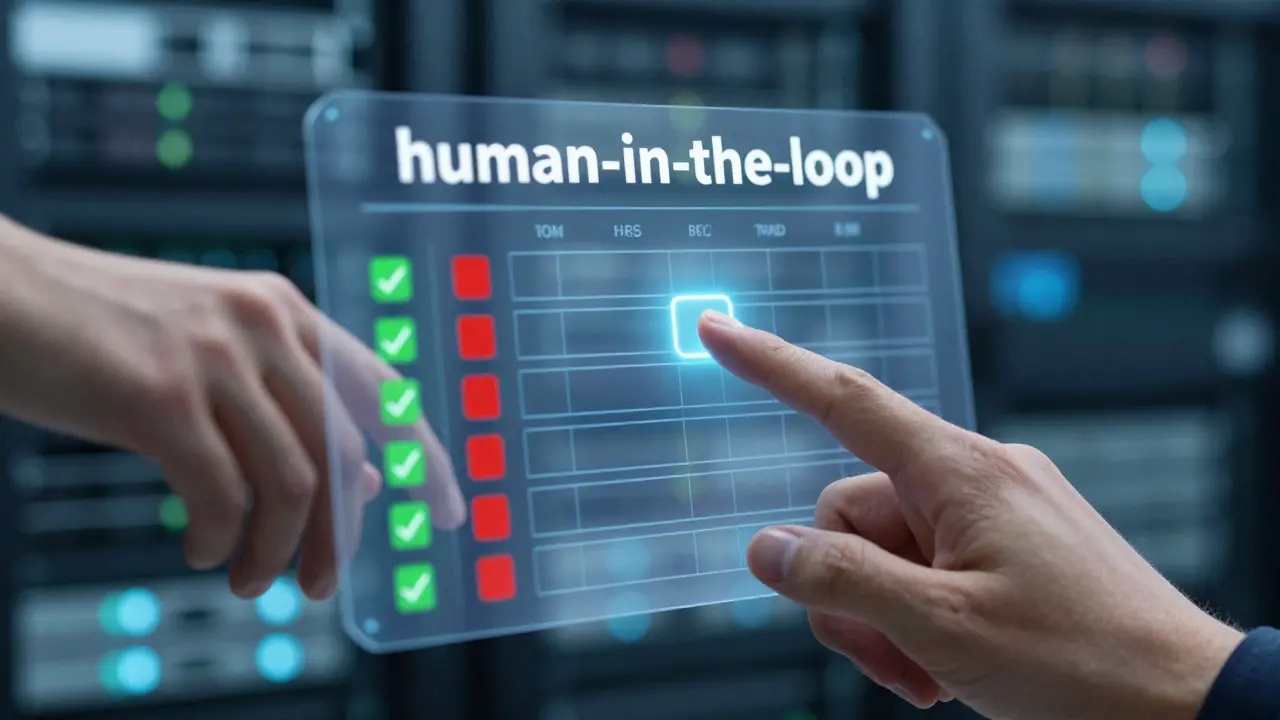
The Human-in-the-Loop: Trust and Ethics
Despite these advancements, AI is not infallible. In fact, relying on it blindly can be dangerous. This is why the concept of "human-in-the-loop" (HITL) has become critical in 2026. AI should make suggestions, but humans must make final decisions, especially in high-stakes areas like healthcare, law, and finance.
One major concern is bias. AI models are trained on historical data, which often contains historical biases. If a hiring algorithm is trained on resumes from a company that historically hired mostly men for technical roles, it might learn to penalize resumes containing the word "women's" (e.g., "women's chess club captain"). Companies are now investing heavily in Explainable AI (XAI), which provides transparency into how an AI reached a decision. This allows auditors to check for fairness and accuracy.
Data privacy is another hurdle. With regulations like GDPR in Europe and various state-level laws in the US, businesses must ensure their AI systems handle personal data responsibly. Anonymization techniques and federated learning (where AI learns from data without moving it from the source) are becoming standard practices to protect customer privacy while still gaining insights.
Implementation Challenges: Why Most Projects Fail
You might be thinking, "Okay, let’s build an AI model." Hold on. The technology is only half the battle. The other half is organizational readiness. Many AI projects fail not because the algorithms are bad, but because the data is messy or the culture is resistant.
- Data Silos: AI thrives on large, clean, integrated datasets. If your sales data is in one system, your customer support data in another, and your logistics data in a third, your AI will have a fragmented view of reality. Breaking down these silos is often the first step before any AI work begins.
- Skill Gaps: You don’t need everyone to be a data scientist, but you do need employees who can ask the right questions and interpret the results. Upskilling programs are essential. Teaching marketers how to prompt LLMs effectively or teaching managers how to read predictive dashboards is crucial.
- Change Management: People fear what they don’t understand. Employees may worry that AI will replace them. Leadership must communicate clearly that AI is a tool to enhance their work, not eliminate it. Involve employees in the selection and testing of AI tools to build trust and ownership.
Looking Ahead: The Next Frontier
As we move further into 2026 and beyond, the integration of AI will become even deeper. We are seeing the rise of autonomous agents-AI systems that can execute multi-step tasks with minimal human intervention. Imagine an AI agent that negotiates with suppliers, places orders, tracks shipments, and updates inventory records automatically, alerting a human manager only when exceptions occur.
Additionally, the convergence of AI with other technologies like the Internet of Things (IoT) and blockchain will create new possibilities. Smart factories with IoT sensors feeding data to AI systems for predictive maintenance will become the norm. Blockchain could provide the immutable audit trails needed to verify the integrity of AI training data.
The businesses that thrive will be those that treat AI not as a project with a finish line, but as a continuous journey of adaptation. They will invest in data infrastructure, foster a culture of experimentation, and always keep the human element central to their strategy.
Is AI going to replace my job?
In most cases, no. AI is more likely to automate specific tasks within your job rather than replace the entire role. Jobs that involve creativity, complex problem-solving, emotional intelligence, and strategic thinking are less susceptible to full automation. However, jobs that consist primarily of repetitive, rule-based tasks are at higher risk. The key is to adapt by learning how to use AI tools to enhance your productivity.
What is the difference between Generative AI and Machine Learning?
Machine Learning (ML) is a broader field where computers learn from data to make predictions or decisions without being explicitly programmed for every scenario. Generative AI is a subset of ML focused on creating new content, such as text, images, audio, or video. While ML might predict next quarter's sales, Generative AI might write the marketing email announcing the new products.
How much does it cost to implement AI in a small business?
It varies widely. You don't need to build custom models from scratch. Many small businesses can start with off-the-shelf SaaS AI tools for customer service, marketing, or accounting, which may cost anywhere from $50 to $500 per month. Building custom enterprise-grade AI solutions can cost tens of thousands of dollars in development and infrastructure. Start small with clear use cases and scale up as you see ROI.
What are the biggest risks of using AI in business?
The main risks include data privacy breaches, algorithmic bias leading to unfair outcomes, over-reliance on AI without human oversight, and hallucinations (where AI generates plausible but incorrect information). Mitigating these risks requires robust data governance, regular auditing of AI systems, and maintaining human-in-the-loop processes for critical decisions.
Do I need to hire data scientists to use AI?
Not necessarily for initial adoption. Many AI tools today are designed for non-technical users. However, as your AI usage grows and becomes more integrated into core business processes, having data literacy across teams or hiring specialized talent becomes beneficial. For complex, custom solutions, data scientists and engineers are essential.